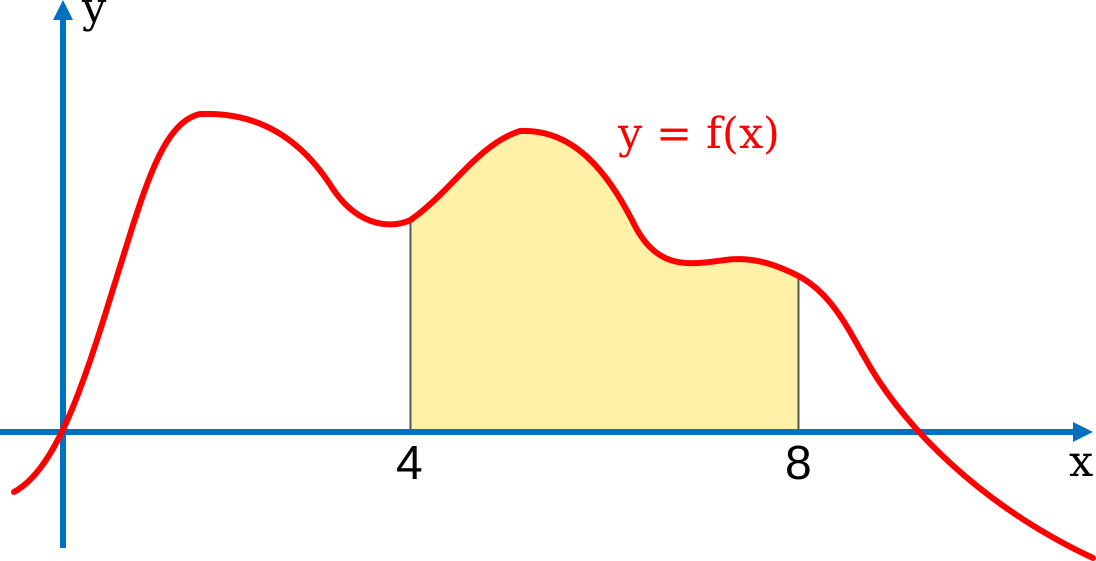
The gradient of \(f(x)\) when \(x=4\) is \(1\).
The area under the curve \(y=f(x)\) between \(x=4\) and \(x=8\) is \(12\) square units.
Which of the following expressions can be evaluated from this information?
| Gradient to be evaluated | Answer |
|---|---|
| The gradient of \(y=f(x)+3\) at \(x=4\) | |
| The gradient of \(y=-f(x)\) at \(x=4\) | |
| The gradient of \(y=5f(x)\) at \(x=4\) | |
| The gradient of \(y=f(x+2)\) at \(x=4\) | |
| The gradient of \(y=f(x-1)\) at \(x=3\) | |
| The gradient of \(y=f(x+3)\) at \(x=1\) | |
| The gradient of \(y=f(-x)\) at \(x=-4\) | |
| The gradient of \(y=f'(x)\) at \(x=4\) | |
| The gradient of \(y=f''(x)\) at \(x=4\) | |
| The gradient of \(y=f''(x-3)\) at \(x=4\) |
| Integral to be evaluated | Answer |
|---|---|
| \(\displaystyle \int_{4}^{8}\bigl(f(x)+7\bigr)\,dx\) | |
| \(\displaystyle \int_{4}^{8}\bigl(f(x)-5\bigr)\,dx\) | |
| \(\displaystyle \int_{2}^{6}f(x+2)\,dx\) | |
| \(\displaystyle \int_{4}^{8}f(x-2)\,dx\) | |
| \(\displaystyle \int_{4}^{8}-f(x)\,dx\) | |
| \(\displaystyle \int_{4}^{8}f(-x)\,dx\) | |
| \(\displaystyle \int_{4}^{8}5f(x)\,dx\) | |
| \(\displaystyle \int_{-8}^{-4}f(-x)\,dx\) | |
| \(\displaystyle \int_{1}^{2}f(4x)\,dx\) | |
| \(\displaystyle \int_{3}^{7}\bigl(f(x+1)+2\bigr)\,dx\) |
Sign in to your Transum subscription account to see the answers
This maths lesson starter is designed to be projected onto a whiteboard to initiate whole-class discussion.
More Advanced Maths Lesson Starters here.
This activity was inspired by the resource called "What else do you know?" from Underground Mathematics.